AI voice assistant IVR is redefining what customers expect when they pick up the phone to call a business. With a AI voice assistant IVR, callers can now speak naturally, get instant answers, and be routed to exactly the right place in seconds. As highlighted in TechBullion coverage on virtual agent technology, this technology helps businesses scale support efficiently while maintaining high-quality interactions. Platforms like Bright Pattern for smarter AI customer interactions enable companies to deliver seamless experiences, boosting satisfaction and reducing operational costs.
Businesses today are exploring the latest cloud computing research projects to streamline processes and improve system performance. Meanwhile, staying informed about advanced supercomputer technology developments helps teams leverage cutting-edge tools for faster data processing and analytics.
On the marketing side, companies adopting customer-focused digital marketing strategies are seeing stronger engagement and improved brand loyalty. Additionally, innovative marketing campaign tracking platforms allow brands to optimize digital campaign performance with precision. For financial planning and insights, accessing essential online financial resource tools ensures smarter investment decisions and scalable growth strategies.
Integrating these technological advancements creates more efficient operations and enhances the overall customer experience. Automated systems, real-time analytics, and strategic insights come together to form smarter business workflows. This combination empowers companies to reduce costs, improve response times, and build stronger relationships with customers—without compromising quality or service.
Top 10 AI Contact Center Solutions for Smarter Customer Service
AI voice assistant IVR is transforming how businesses handle customer interactions, enabling faster, more accurate responses and reducing wait times. The following list highlights the top AI contact center solutions available today, helping companies choose the best platform for their needs.
1. Bright Pattern – AI Contact Center Platform
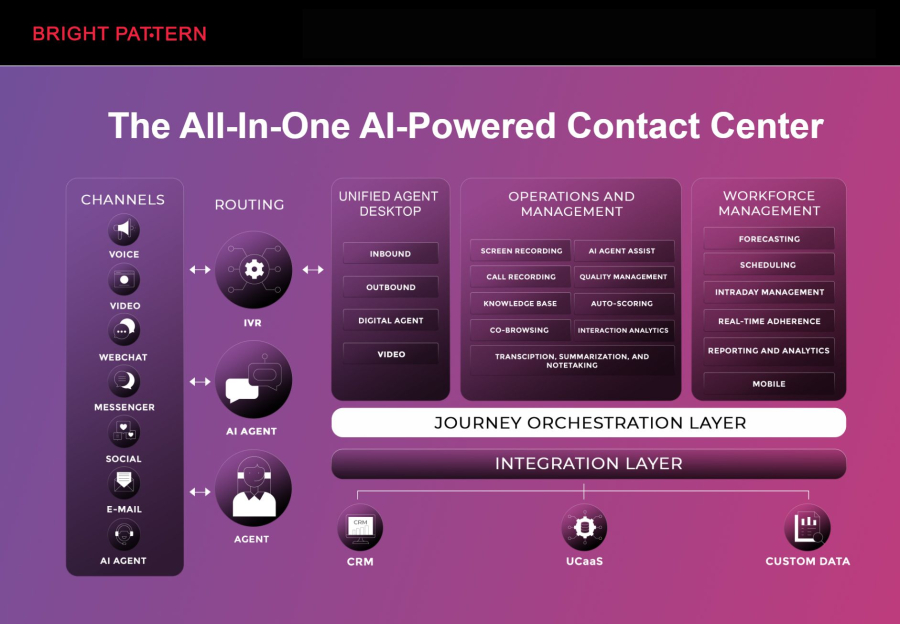
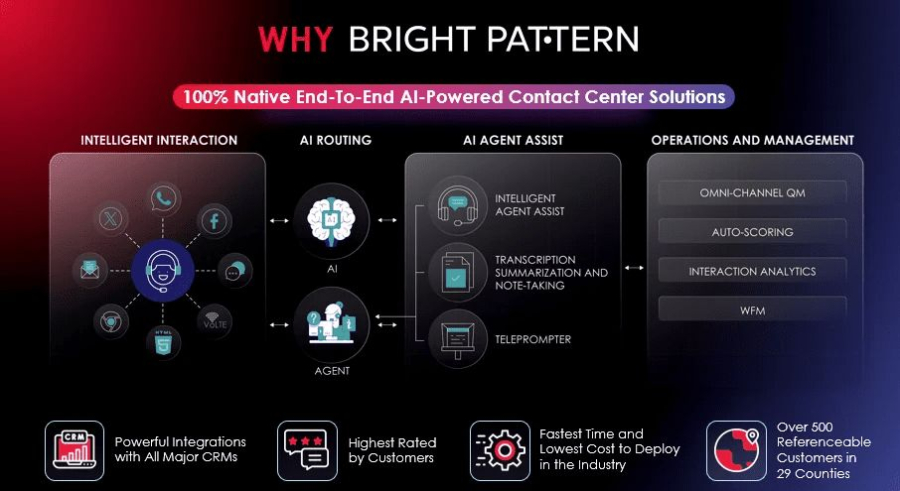
Bright Pattern leads the market in AI-driven contact center solutions, offering seamless integration with AI voice assistant IVR technology. It provides businesses with the tools to automate, personalize, and optimize customer interactions across multiple channels.
Key features include:
- Omnichannel support including voice, chat, email, and messaging apps
- AI-powered routing and intelligent call distribution
- Advanced analytics for real-time performance monitoring
- Virtual agent capabilities for handling routine queries automatically
- Easy integration with CRM and other business tools
Bright Pattern’s platform helps organizations reduce operational costs, improve response times, and deliver consistent customer experiences while scaling efficiently. Its AI-driven contact center solutions are ideal for businesses looking to implement a modern, automated, and customer-centric service strategy.
2. Genesys Cloud CX
Genesys Cloud CX offers a comprehensive suite of AI-enabled contact center solutions, including predictive routing, AI chatbots, and workforce optimization tools.
3. Five9 Intelligent Cloud Contact Center
Five9 provides cloud-based call center software with AI voice assistant IVR, CRM integrations, and real-time reporting capabilities to enhance customer engagement.
4. NICE inContact CXone
CXone from NICE inContact combines AI, analytics, and automation to improve agent efficiency and deliver better customer experiences across multiple channels.
5. Talkdesk AI Contact Center
Talkdesk delivers AI-driven call center solutions with virtual assistants, advanced routing, and data-driven insights for enhanced operational performance.
6. Avaya OneCloud CCaaS
Avaya OneCloud offers a cloud contact center solution with AI features for omnichannel engagement, including voice, chat, and social media support.
7. Cisco Webex Contact Center
Cisco Webex integrates AI-powered virtual agents, advanced reporting, and real-time analytics to streamline call center operations and improve customer satisfaction.
8. RingCentral Contact Center
RingCentral provides a cloud-based AI contact center platform with intelligent routing, virtual agents, and detailed reporting tools for efficient service delivery.
9. 8x8 Contact Center
8x8 offers AI-enhanced contact center solutions with real-time speech analytics, automated workflows, and virtual agent support for faster resolution.
10. Zendesk Sunshine Conversations
Zendesk Sunshine Conversations delivers AI-enabled customer engagement across messaging channels, voice, and chat, helping businesses manage interactions efficiently.
What Is an AI Voice Assistant IVR?
AnAI voice assistant IVRcombines traditional interactive voice response (IVR) with modern artificial intelligence, speech recognition, and natural language understanding. Instead of forcing callers to press numbers or repeat rigid phrases, the system understands spoken language and responds conversationally.
In practice, this means a caller can say something like, “I want to update my payment method” and the AI immediately understands the intent, verifies the caller if needed, and either completes the task or routes them to the right specialist.
Key Components of AI Voice Assistant IVR
- Automatic Speech Recognition (ASR)that converts spoken words into text in real time.
- Natural Language Understanding (NLU)that interprets intent, context, and key details from what the caller says.
- Dialog Managementthat guides the conversation, asks clarifying questions, and keeps the interaction on track.
- Text-to-Speech (TTS)that generates humanlike spoken responses.
- Integrationswith CRM, ticketing, billing, and other back-office systems to perform actions, not just answer questions.
Why Businesses Are Upgrading to AI Voice IVR
Modern contact centers are under pressure to do more with less: handle higher volumes, meet rising customer expectations, and control costs. AI voice assistant IVR hits all three goals at once.
1. Natural, Frictionless Conversations
Traditional IVR systems force callers through rigid menus. AI voice assistants feel more like speaking to a skilled human agent.
- Callers can use everyday language instead of memorizing options.
- The system can handle interruptions, digressions, and follow-up questions.
- Conversations adapt to each caller instead of forcing everyone down the same tree.
The result is a smoother, more intuitive experience that reduces frustration and increases the likelihood of self-service success.
2. 24/7 Availability Without Extra Headcount
An AI voice assistant IVR never sleeps. It is always available to answer questions, resolve common requests, and triage urgent issues.
- After-hours supportwithout the cost of full overnight staffing.
- Peak-time coveragewhen call volumes spike unexpectedly.
- Global coverageacross time zones and regions.
This always-on availability strengthens your brand reputation and ensures customers can get help whenever they need it.
3. Higher First-Call Resolution
Because AI-powered IVR understands context and customer history, it can resolve more issues on the first call.
- Identifying returning callers and referencing previous interactions.
- Pulling account data to personalize answers and actions.
- Routing complex issues directly to the right agent with full context attached.
Fewer transfers and repeat calls mean happier customers and lower overall contact volume.
4. Reduced Operating Costs
Every call that is resolved by your AI assistant instead of a human agent directly lowers handling costs. Over time, this creates substantial savings while freeing human agents to focus on high-value, complex interactions.
- Deflect routine calls such as balance checks, order status, or password resets.
- Shorten talk time and handle time by gathering information before an agent joins.
- Scale up to handle surges in call volume without hiring in parallel.
5. Consistent, Brand-Aligned Service
An AI voice assistant IVR can be carefully designed to reflect your brand voice and follow your policies every time, with no variation between one interaction and the next.
- Standardized greetings, disclosures, and compliance scripts.
- Unified tone and language across product lines and regions.
- Instant updates to messaging when offers or policies change.
This brings a sense of reliability and professionalism to every call.
AI Voice Assistant IVR vs. Traditional IVR
Upgrading to AI often feels like moving from a touch-tone maze to a personal concierge. The table below highlights the difference.
| Aspect | Traditional IVR | AI Voice Assistant IVR |
| Interaction style | Menu-based, press 1-2-3 | Conversational, natural language |
| Flexibility | Rigid call flows | Adaptive, context-aware paths |
| Self-service capability | Limited to simple queries | Handles a wide range of tasks and workflows |
| Customer experience | Often frustrating and slow | Fast, intuitive, and personalized |
| Scalability | Requires more agents as volume grows | Scales virtually without linear staffing costs |
| Data and insights | Basic reporting | Rich analytics on intent, sentiment, and journeys |
High-Impact Use Cases for AI Voice Assistant IVR
AI voice IVR can enhance almost any phone-based customer interaction, but some use cases deliver especially strong results.
Banking and Financial Services
- Balance inquiries and recent transactions.
- Card activation, PIN changes, and basic account updates.
- Lost or stolen card triage with rapid routing to fraud teams.
- Loan application status checks and payment reminders.
With secure verification flows, banks can offer fast, convenient self-service while maintaining trust and compliance.
E-commerce and Retail
- Order status, shipping updates, and delivery tracking.
- Returns, exchanges, and product availability checks.
- Loyalty program balance and reward redemption assistance.
AI voice assistants can deflect the most common logistics and order questions, leaving agents more time for sales and complex issues.
Telecommunications and Utilities
- Outage information and restoration time estimates.
- Bill explanations, due dates, and payment processing.
- Plan upgrades, add-ons, and service changes.
For high-volume sectors, even modest improvements in self-service adoption translate into massive savings and higher satisfaction.
Healthcare and Insurance
- Appointment scheduling, reminders, and rescheduling.
- Coverage questions, plan details, and copay information.
- Claim status updates without needing an agent.
AI-powered IVR supports patients and members with fast, accurate information, while staff focus on clinical and high-touch tasks.
Core Capabilities That Make AI Voice IVR So Powerful
Behind the scenes, several capabilities work together to deliver a smooth experience. Understanding these helps you design solutions that really shine.
Natural Language Understanding (NLU)
NLU lets your system interpret what callers mean, not just what they say. It identifies intents (for example, pay a bill, check order status), key entities (dates, amounts, account numbers), and sentiment.
- Handles variations in phrasing, accents, and speaking styles.
- Makes intelligent guesses and asks clarifying questions when needed.
- Improves over time as it is exposed to more real interactions.
Context Awareness and Memory
A strong AI IVR does not treat each utterance as separate. It remembers context within the call and, when appropriate, across calls.
- Understands follow-up questions like “What about next month?” without repeating details.
- Recognizes returning callers and tailors suggestions based on history.
- Maintains state across multi-step workflows such as onboarding or applications.
Omnichannel Alignment
Customers do not think in channels; they just want answers. AI voice assistant IVR can align with chatbots, messaging, and web experiences to create a seamless journey.
- Share knowledge bases and business rules between voice and digital bots.
- Use the same intents and workflows wherever customers reach out.
- Hand off from self-service to human agents in any channel, with full context.
Designing a High-Performing AI Voice Assistant IVR
Success with AI IVR is not just about technology; it is about thoughtful design. When you build with the customer experience at the center, performance and ROI follow naturally.
1. Start With Clear Objectives
Define what you want the system to achieve before you start building.
- Increase self-service rate for specific call types.
- Reduce average handle time or queue times.
- Improve first-call resolution or customer satisfaction scores.
Focused objectives guide your design decisions and make it easier to measure success.
2. Prioritize High-Volume, High-Impact Journeys
Begin by automating tasks that are both common and straightforward. These deliver the fastest wins.
- Top 10 reasons callers contact your business.
- Processes with clear rules and predictable steps.
- Tasks that currently consume a lot of agent time but add limited value.
You can always expand to more complex use cases once the foundation is running smoothly.
3. Design Conversations, Not Menus
Move beyond thinking in terms of menus and branches. Instead, map out how a real conversation should feel.
- Use open prompts such as “How can I help you today?”
- Offer gentle guidance: mention a few examples of what callers can say.
- Plan for interruptions, corrections, and unexpected questions.
This approach creates an experience that feels intuitive from the caller’s first words.
4. Build a Smooth Escalation Path to Human Agents
Even the best AI assistant will not handle every scenario. The key is to make escalation effortless and contextual.
- Transfer at the right moment, not as a last resort.
- Pass along history from the IVR interaction so callers do not repeat themselves.
- Route to the most qualified agent based on intent and context.
When automation and human expertise work together, the caller experience feels seamless and supportive.
5. Continuously Optimize With Real Data
AI voice IVR improves over time, especially when you feed it data-driven insights.
- Analyze common failure points where callers ask for an agent.
- Refine prompts and flows based on real utterances and transcripts.
- Expand successful flows to cover more tasks and variations.
With regular tuning, performance gains compound and automation rates steadily climb.
Key Metrics to Track for AI Voice Assistant IVR Success
Measuring performance helps you demonstrate business impact and identify new opportunities to improve.
Customer Experience Metrics
- Customer Satisfaction (CSAT)after calls that use the AI IVR.
- Net Promoter Score (NPS)trends as experiences improve.
- Call abandonment rateas menus become more intuitive and fast.
Operational Efficiency Metrics
- Containment rate(percentage of interactions resolved entirely within the IVR).
- Average handle timereduction after introducing AI triage.
- Agent occupancy and productivityas routine work is automated.
Business Impact Metrics
- Cost per contactcompared to pre-AI baselines.
- Upsell and cross-sell conversionfrom targeted offers during calls.
- Retention and churnmovements linked to improved support experiences.
Future Trends: Where AI Voice IVR Is Heading
AI voice assistant IVR is evolving quickly, bringing even more value to both businesses and customers.
More Humanlike Conversations
Advances in speech synthesis and language models are making AI voices sound more natural, empathetic, and context aware. This reduces the “robotic” feel and encourages greater adoption of self-service.
Proactive and Predictive Experiences
Instead of passively responding, AI IVR will increasingly anticipate needs.
- Offering help based on recent activity or known issues.
- Reaching out with reminders and updates before customers have to ask.
- Predicting call reasons and pre-loading relevant data for faster resolution.
Deeper Integration Across the Customer Journey
AI voice assistants are becoming central hubs for orchestration across sales, service, and marketing.
- Sharing insight with digital channels to create a unified view of the customer.
- Triggering personalized offers and follow-ups based on call content.
- Informing product and policy decisions with rich intent analytics.
Getting Started With AI Voice Assistant IVR
Implementing an AI voice assistant IVR does not have to be overwhelming. A staged, strategic rollout lets you deliver visible wins early and expand confidently.
- Assess your current IVR and call flows.Identify bottlenecks, high-volume intents, and areas where callers struggle.
- Define success metrics.Choose a small set of KPIs such as containment, CSAT, or handle time.
- Prioritize and prototype.Start with two to five high-value use cases and build a pilot experience.
- Launch, listen, and learn.Monitor performance, review call transcripts, and refine prompts and flows.
- Scale and enrich.Add more intents, deeper integrations, and advanced capabilities as you gain confidence.
With this approach, you can unlock the benefits of AI voice automation quickly, while steadily building a sophisticated, high-performing IVR over time.
Conclusion: Turn Your Phone Line Into a Smart, Always-On Assistant
AI voice assistant IVR is more than an upgrade to traditional phone menus. It is a powerful new way to serve customers: conversational, always available, and tightly integrated with the systems that run your business.
By combining natural language understanding, intelligent routing, and seamless escalation to human agents, you can turn every inbound call into an opportunity to impress, support, and retain your customers – at scale. Organizations that embrace this technology today are setting the standard for effortless, modern customer experiences on the most familiar channel of all: the humble phone call.
